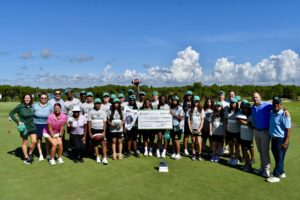

PACIFIC PALISADES, CALIF. (June 7, 2026) – The United States Golf Association today presented Marshall Dick, The Riviera Country Club’s golf course superintendent, with the E.J. Marshall Platter after play finished at the 81st U.S. Women’s Open Presented by Ally.
Dick, a member of the Golf Course Superintendents Association of America (GCSAA), has spent 14 years at Riviera. In preparation for the U.S. Women’s Open, Dick and his grounds team worked side by side with USGA Senior Director of Championship Agronomy Darin Bevard to get the iconic course ready for the world’s best female golfers.
Created in 2022, the E.J. Marshall Platter celebrates quality in golf course management, acknowledging golf course maintenance leaders who demonstrate dedication, expertise and seamless collaboration with the USGA ahead of a national championship. The recognition also extends a salute to the entire Riviera golf course maintenance team and its fleet of championship volunteers for their vital contributions.
“Marshall and his entire team have been phenomenal partners throughout this entire process,” said Bevard. “Preparing a historic venue like Riviera for a national championship presents a unique set of challenges, but Marshall’s agronomic expertise, attention to detail and leadership ensured that the course was in ideal condition. He is incredibly deserving of this honor.”
Under Dick’s leadership, his team of 32 has fine-tuned Riviera’s classic George C. Thomas Jr. design for the U.S. Women’s Open. Known for its distinct Kikuyugrass fairways and rough, as well as its smooth, firm Poa annua greens, the course required precise management to achieve the standards expected for a USGA championship. Riviera is also set to host the men’s and women’s Olympics competition in 2028, and the 131st U.S. Open Championship in 2031.
Dick’s path in turfgrass management is rooted in a deep passion for the science of golf course care. He built his foundational knowledge through specialized turfgrass studies before working his way up through top-tier golf facilities, earning a reputation for meticulous standards and strong crew leadership.
The E.J. Marshall Platter’s namesake was the chair of the green committee at the Inverness Club in Toledo, Ohio, in 1920. After he approached the USGA and the U.S. Department of Agriculture for help at the course ahead of the U.S. Open, the USGA formed the Green Section to provide course care expertise, agronomic research and sustainability tools to golf facilities worldwide.
About the USGA
The USGA is a mission-based golf organization whose purpose is to unify the golf community through handicapping and grassroots programs; to showcase the game’s best talent through the U.S. Open, U.S. Women’s Open Presented by Ally and 13 other national championships and our museum; to provide unbiased global governance with The R&A through the playing, equipment and Amateur Status rules; and to advance issues important to golf’s future, with a focus on driving sustainability, accessibility and inclusion. The USGA also manages day-to-day operations for the U.S. National Development Program, the country’s first unified pathway for American talent, and the World Golf Hall of Fame, preserving and celebrating the legacies of the game’s greatest figures. As a nonprofit association, our work and our team are driven to act for the good of the game. For more, visit usga.org.
About the USGA Green Section:
Since the founding of the Green Section in 1920, the USGA has led the effort to enhance golf course sustainability. Through research and services to courses that enable improved playing conditions, these efforts are aimed at reducing the consumption of critical resources such as water, chemicals, labor and energy. This mission is achieved through five primary programs – research, course consulting services, technology tools, championship agronomy and professional education and outreach. The USGA’s annual investment of $10 million in science, research, agronomy and course consulting efforts is estimated to provide more than $1.9 billion in savings to U.S. golf courses each year. These savings are realized through more efficient water, fuel, labor and nutrient management practices all while supporting improved playing conditions, for the good of the game.